Series 01, DocumentariesNovember 19, 2026
Jensen Huang Was Gone for 11 Days. Here's How He Built Nvidia
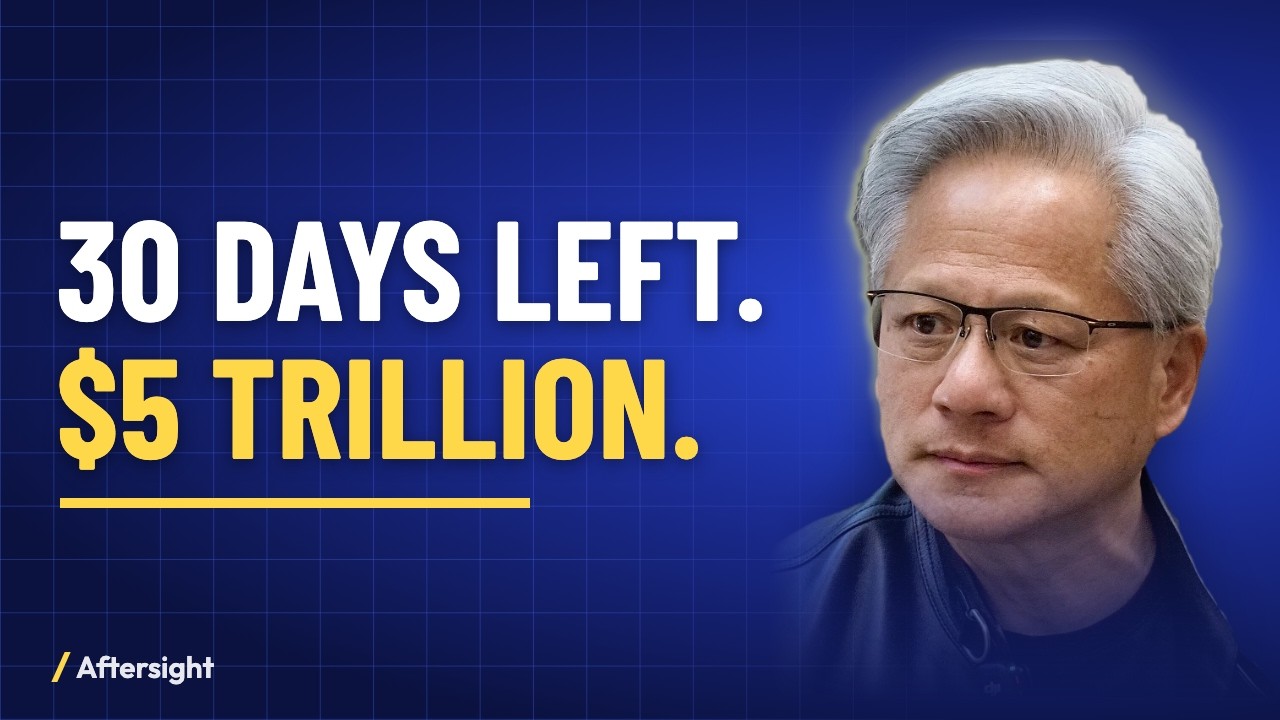
Thumbnail photo: Anderseidesvik, CC BY-SA 4.0, via Wikimedia Commons.

The player loads from YouTube (privacy-enhanced mode) only when you press play. Until then this page makes no request to YouTube or Google.
Watch on YouTubeIn 1997, Nvidia was thirty days from going out of business. In October 2025, it became the first company ever worth $5 trillion. On November 12, 2026, Jensen Huang, who came up with the idea for it in a Denny's and co-founded it in 1993, stepped down after 33 years. Eleven days later, on November 23, the board brought him back.
This is the full story: the failed first chip, the deal with Sega that saved the company, the first GPU, the "vacuum cleaner" GeForce FX, CUDA, the bet on AI, two walls of regulation, and the climb to trillions. And the question that remains: what does Nvidia look like after the week it almost lost its founder?
- Series
- 01, Documentaries
- Released
- November 19, 2026
- Subject
- Nvidia
Chapters
Main sources
1993 to 1999: Founding, near-collapse, first GPU 14
- NvidiaCorporate timeline
- FortuneNvidia's forgotten co-founder, Curtis PriemApr 5, 2024
- Jon Peddie ResearchNvidia's quadratic processor: the NV1 (Chasing Pixels)via IEEE Computer Society
- Vintage3DNV1
- WikipediaNV1
- Tom's HardwareNvidia graphics cards through the years (picture story)
- WikipediaShoichiro Irimajiri
- The Next WebHow Sega's $5 million saved NvidiaJul 15, 2026
- Time ExtensionFlashback: how the kindness of Sega saved Nvidia from going underApr 30, 2024
- WikipediaRIVA 128The "thirty days" motto is quoted there from The New Yorker (Stephen Witt, Nov 27, 2023)
- DFarqNvidia's IPO on January 22, 1999
- The Motley FoolWhat $5,000 in Nvidia stock in 1999 is worth todayJul 21, 2026
- ComputerBaseGeForce 256 (NV10) retrospectiveIn GermanSep 2020
- WikipediaGeForce 256
2000 to 2006: Xbox, 3dfx, ATI 14
- NvidiaSEC filing, Xbox contract with Microsoft2000
- NvidiaSEC filing, Quadro22000
- The Register3dfx sues archrivalSep 22, 1998
- The Register3dfx damns Nvidia patent suitAug 30, 2000
- Wikipedia3dfx Interactive
- WikipediaDirectX
- The RegisterGeForce 3 details emergeFeb 22, 2001
- Tom's HardwareThe GeForce3 launched 25 years ago
- TechPowerUpGeForce3 specifications
- AnandTechGeForce FX 5800 Ultra reviewJan 27, 2003
- AnandTechGeForce FX 5800 Ultra review, performanceJan 27, 2003
- AnandTechGeForce FX 5800 Ultra review, priceArchived copy (Wayback Machine), the original link no longer worksJan 27, 2003
- ComputerBaseGeForce FX 5800 retrospectiveIn GermanApr 2018
- AnandTechSLI (Scalable Link Interface)
2006 to 2015: CUDA and the first steps beyond gaming 21
- AnandTechGeForce 8800 GTX reviewArchived copy (Wayback Machine), the original link no longer works
- TechPowerUpGeForce 8800 GTX specifications
- Jon Peddie ResearchHow the 8800 GTX laid the foundation for AI computing
- Beyond3DCUDA
- bit-techNvidia joins the GPGPU race (Tesla C870)
- TechPowerUpNvidia unveils Tesla GPU computing processor
- WikipediaTegra
- Android AuthorityNvidia's phone chips
- AnandTechGeForce GTX 480 review
- bit-techGeForce GTX 480 1.5 GB review
- NvidiaPress release, first GeForce GPUs based on Kepler (GTX 680)
- AnandTechGeForce GTX 680 review
- WikipediaAlexNet
- Krizhevsky, Sutskever and HintonImageNet classification with deep convolutional neural networks (AlexNet paper)PDF copy2012
- WikipediaGeoffrey Hinton
- WikipediaIlya Sutskever
- The New YorkerGeoffrey Hinton profileNov 20, 2023
- nobelprize.orgNobel Prize in Physics 2024, press releaseOct 8, 2024
- Tom's HardwareTegra 4 and Shield, July 31
- AnandTechGeForce GTX 980 and 970 (Maxwell)
- NvidiaPress release, Maxwell GPU architecture
2016 to 2022: From GPU maker to AI data center 23
- HPCwireNvidia's monster Pascal GPU card at GTC16Apr 5, 2016
- TOP500Nvidia delivers DGX-1 supercomputer in a box to OpenAI
- FortuneElon Musk, OpenAI and the Nvidia supercomputerAug 15, 2016
- AnandTechNvidia announces the GeForce GTX 1080 and 1070Archived copy (Wayback Machine), the original link no longer works
- NvidiaPress release, GeForce GTX 1080
- The RegisterGTX 970 settlementJul 28, 2016
- WikipediaVolta (microarchitecture)
- HPCwireNvidia launches Volta GPU platform
- TOP500Nvidia raises the performance bar with Volta GPU
- WikipediaDeep Learning Super Sampling
- WikipediaGeForce RTX 20 series
- AnandTechGeForce RTX 20 series
- HPCwireNvidia completes acquisition of Mellanox
- NvidiaPress release, completes acquisition of Mellanoxvia NasdaqApr 27, 2020
- HPCwireNvidia's next-gen Ampere GPU: 2.5x the performance, 20x the trainingMay 14, 2020
- Tom's HardwareNvidia Ampere architecture deep diveMay 2020
- AI BusinessNvidia's Arm deal, the largest chip merger ever, terminatedLink as given in our research notes
- Electronic DesignNvidia's $40 billion bid for Arm falls apart under regulatory pressure
- HPCwireNvidia announces Hopper architecture
- The RegisterNvidia's H100 GPUMar 22, 2022
- NvidiaBlog, AI factories, Hopper H100Mar 22, 2022
- NvidiaFinancial results, fourth quarter and fiscal 2022
- NvidiaForm 8-K, export license requirementAug 26, 2022
2023 to 2026: The AI boom, export limits, Blackwell and Rubin 33
- CSISInsight: U.S. semiconductor export controls update
- Silicon RepublicExport controls on Nvidia chips
- BrookingsBall games over: the US is out of the AI chip market in China
- NvidiaForm 8-K, export license requirement for H20Apr 9, 2025
- NvidiaFinancial results, first quarter fiscal 2026
- HPCwireNvidia introduces new Blackwell GPU for trillion-parameter AI modelsMar 19, 2024
- NvidiaPress release, Blackwell platform arrives
- Games MarketCES 2025: Nvidia GeForce RTX 50 series, DLSS 4 and neural rendering
- Jon Peddie ResearchGeForce RTX 50 series
- SemaforDeepSeek's new AI model rattles US tech stocksJan 27, 2025
- Tom's HardwareNvidia loses $589 billion in market cap after DeepSeek release
- NvidiaBlog, Nintendo Switch 2 with Nvidia AI-powered DLSSApr 3, 2025
- NvidiaPress release, Jetson Thor now available
- ABC11Nvidia crowned first public company with a $4 trillion valuationAP story
- ABC7 NewsNvidia crowned first public company with a $4 trillion valuationAP story
- TechRepublicNvidia's $4 trillion market value
- BoardroomNvidia: everything you need to know
- CNBCNvidia on track to hit historic $5 trillion valuationOct 29, 2025
- FortuneNvidia becomes the first $5 trillion companyOct 29, 2025
- TweakTownNvidia shows off its next-gen Vera Rubin superchip at GTC Washington
- NvidiaPress release, Vera Rubin ramps into full production
- Yahoo FinanceNvidia hits record high
- 24/7 Wall St.Nvidia is now worth more than Meta, Amazon and AMD combinedOct 6, 2026
- Silicon AnalystsAMD vs Nvidia: AI GPU market share 2026Analyst estimate
- AIMultipleAI chip makersIncludes SemiAnalysis tests and Morgan Stanley estimates
- TrendForceAI server forecast for 2026TrendForce forecast, via AIMultiple
- WikipediaNvidiaIntel investment, September 2025
- NvidiaForm 10-K, fiscal 2026
- NvidiaFinancial results, fiscal 2026
- NvidiaForm 10-Q, quarter ended July 26, 2026
- NvidiaFinancial results, second quarter fiscal 2027
- NvidiaCFO commentary, second quarter fiscal 2027
- Tom's HardwareNvidia enjoys $130 billion annual earnings despite gaming supply constraints
November 2026: Huang steps down 10
- NvidiaForm 8-K, CEO transitionNov 12, 2026
- NvidiaPress release, CEO transitionNov 12, 2026
- FortuneHuang's exit and the reports about itNov 11, 2026
- Al JazeeraWhy did Nvidia CEO Jensen Huang resign, and who is Colette Kress?Nov 12, 2026
- Yahoo FinanceNvidia live updates: Huang resigns, Colette Kress to serve as interim CEONov 12, 2026
- NvidiaFinancial results, third quarter fiscal 2027Nov 17, 2026
- CNBCNvidia earnings report, Q3 fiscal 2027Nov 17, 2026
- APNvidia chair says board does not intend to reinstate Jensen Huang as CEOvia PBS NewsHour
- Al JazeeraNvidia shoots down calls for Jensen Huang's return amid strong earningsNov 18, 2026
- CNBCInterim CEO Kress addresses staff after Huang's exitNov 18, 2026
Where sources differ, the video says so.
Read the transcript
Transcript
Cold open
“Our company is thirty days from going out of business.”
That was the unofficial motto at Nvidia.
Less than thirty years later, it becomes the first company in the world worth more than five trillion dollars.
And on November 12, 2026, the man who led it for 33 years steps down.
This is how Nvidia got there.
An idea in a diner
It starts at a table in a Denny's in San Jose. Three engineers meet there: Chris Malachowsky and Curtis Priem, both from Sun Microsystems, and Jensen Huang.
Their idea is a chip that brings real 3D graphics to an ordinary PC, for games and for what was then called multimedia. In April 1993, they make it official. The company is called Nvidia.
Two years later, Nvidia has its first chip, the NV1. Diamond sells it as the Diamond Edge 3D, and the card does a lot at once: 2D, 3D and sound, plus a port for the controllers of Sega's game console, the Saturn.
But the NV1 bets on a different technique. It is built around curved surfaces, while most of the PC industry builds 3D images from triangles.
Then Microsoft announces that its new 3D standard for Windows, Direct3D, will work with triangles too. Game developers choose it, and few of them write for the NV1.
The card sells poorly. Diamond writes off five million dollars in unsold stock, and in early 1996 Nvidia stops selling it.
Meanwhile, Nvidia is already working on its next chip, the NV2, for Sega's next game console. It uses the same curved surfaces the market has just turned its back on. And the money is running out.
Thirty days
Huang flies to Japan to tell Sega himself. He meets Shoichiro Irimajiri, a senior executive there, and says the chip Nvidia is building for them is the wrong design. By later accounts, Nvidia has money for about thirty days.
Then he asks for something unusual. Part of the contract money is still to come. Huang asks Sega to let Nvidia out of the contract and pay that money anyway, as an investment in a company that has just admitted its chip will not work.
Irimajiri takes a couple of days to think about it. Then Sega agrees. Decades later, in Tokyo, Huang thanked him: without Sega, he said, Nvidia would not be here today.
The money buys Nvidia about six months. In that time it drops the curved surfaces and builds a new chip around triangles, the shape Direct3D works with.
The chip is called the RIVA 128. By the time it comes out, Nvidia can pay its staff for one more month.
Inside the company, that turns into a saying. It is the line from the start of this video: Our company is thirty days from going out of business.
This time Nvidia has built what the market wants. The RIVA 128 costs less than the Voodoo card from rival 3dfx and is almost as fast in Direct3D, so PC makers put it in their machines, and Nvidia survives.
For now, though, 3dfx still sets the standard in PC graphics. Nvidia is a small player.
The first GPU
In January 1999, Nvidia goes public. The numbers show how small the company still is.
That summer, it announces a new chip, the GeForce 256, and gives it a new name: the world's first GPU, short for graphics processing unit.
A GPU is a chip that works out images, so the regular processor in your computer doesn't have to. The GeForce 256 takes over transform and lighting: where everything is in a 3D world, and how the light falls on it. Until then, the processor did that work.
The chip is built from millions of transistors, the tiny switches inside every chip. In the fall of 1999, the first cards are in stores.
Partners build the cards and set their own prices, so what one cost depends on the brand.
The next big order comes from Microsoft. It is building its first game console, the Xbox, and in March 2000 it picks Nvidia to make the graphics chip. Microsoft even pays part of the money up front.
By then, Nvidia also sells Quadro, cards for professionals who design in 3D. That line still exists today, under the name RTX Pro.
Then comes the end of the rival that set the standard. In December 2000, 3dfx agrees to sell its graphics assets to Nvidia, including its patents and brand names. Both had sued each other over patents; those cases are dropped. Two years later, 3dfx files for bankruptcy.
A little over three years earlier, Nvidia was trying to keep up with 3dfx. Now it owns its key assets.
Nvidia shows its next chip at an Apple event. In February 2001, during Steve Jobs's keynote at Macworld in Tokyo, the GeForce 3 runs the first demo of Doom 3.
It is the first GPU with programmable shaders. A shader is a small program that decides what a pixel, or a corner of a 3D model, looks like. From now on, game developers can write their own.
By now, Nvidia is one of the leading names in PC graphics.
The vacuum cleaner
In January 2003, Nvidia finally launches the GeForce FX 5800 Ultra. It is months late, and ATI's Radeon 9700 Pro has already been in stores for a while.
Then there is the noise.
AnandTech measures it with the fan at full speed: the Nvidia card is clearly louder than the Radeon. People start calling the cooler the Dustbuster, after a handheld vacuum cleaner.
In AnandTech's tests with anti-aliasing switched on, the older Radeon is about a fifth faster in Unreal Tournament 2003. Both cards have the same list price.
It takes Nvidia more than a year to recover. In April 2004, the GeForce 6800 Ultra puts the company back in the race.
That summer comes SLI: two graphics cards working together on one image. The name comes from an old 3dfx technology. Nvidia had bought the assets of its former rival in 2000.
Then the change comes from outside the graphics market. In 2006, processor maker AMD buys ATI.
From now on, AMD can sell processors and graphics chips together. Nvidia is the last big graphics company that stands on its own, and it has no processor of its own.
That same year, Nvidia launches a chip that will later become the foundation of its AI business.
Computing with a gaming card
The chip is called G80, and it goes into the GeForce 8800 GTX. Gamers buy it as a fast card for their games.
Inside, something has changed. Older chips had separate parts for separate tasks. The G80 has 128 identical cores that can take on any kind of work. That makes it useful for much more than games: for any calculation that can be split into many small pieces.
To make use of that, Nvidia releases CUDA a few months later. With it, programmers can give a graphics chip ordinary calculations, in a variant of the programming language C, without dressing them up as graphics.
There is a catch for those programmers. Code written in CUDA runs on Nvidia chips, and moving it to another manufacturer is not easy. That still works in Nvidia's favor today.
Nvidia also starts building cards that do nothing but compute. The first, the Tesla C870, doesn't even have a connection for a monitor.
It is the beginning of the data center business, which today brings in by far the largest share of Nvidia's revenue.
For years, though, computing brings in little money. Nvidia also tries phones and tablets, with its Tegra chips from 2008, but in phones they never really catch on.
In gaming, the GeForce GTX 480 arrives in 2010, about six months after AMD's competing cards, and reviewers call it hot and loud. Its architecture, Fermi, was designed with computing in mind. Two years later comes the GTX 680, which according to Nvidia does twice as much work per watt as the GTX 580.
Meanwhile, at the University of Toronto, three researchers are working on something else: two students, Alex Krizhevsky and Ilya Sutskever, and their professor, Geoffrey Hinton. Today, Hinton is often called the godfather of AI.
They enter ImageNet, a competition in recognizing images, with a neural network: software that learns from examples instead of following fixed rules. To train it, they use two ordinary gaming cards, GeForce GTX 580s, and CUDA. Training takes five to six days.
Later that year, the results come in. Their entry, AlexNet, makes far fewer mistakes than any other. Years later, Hinton receives a Nobel Prize for his work on neural networks, and Sutskever co-founds OpenAI.
Nvidia itself calls this the beginning of modern AI. The software it built for scientists six years earlier turns out to be exactly what this research needs.
Building for AI
Nvidia also keeps working on games and devices. In 2013 it releases a device of its own: the Shield, a handheld game console that runs Android.
The Shield remains a small product. Tegra's big success comes years later, when Nintendo puts a Tegra chip in the Switch, and its successor uses an Nvidia chip too.
Back in 2014, the GeForce GTX 970 comes out, and buyers discover something. Of its 4 gigabytes of memory, the last half gigabyte is much slower than the rest.
The card also has fewer units for finishing pixels than Nvidia had listed. In the United States, buyers file fifteen class action lawsuits.
Nvidia settles. Buyers in the US can claim thirty dollars per card, and Nvidia admits no wrongdoing.
Meanwhile, Nvidia builds its first computer made just for AI: the DGX-1, a box with eight of its P100 chips and two Intel processors.
The P100 also introduces NVLink, Nvidia's own fast connection between GPUs. When AI is trained, GPUs constantly exchange data, and the regular connection inside a computer was too slow for that.
The first DGX-1 goes to a young research lab in San Francisco: OpenAI, co-founded by Ilya Sutskever. Jensen Huang delivers it in person, and Nvidia says it was a donation.
The next step happens inside the chip. The V100 has Tensor Cores: computing units built for one job, multiplying small blocks of numbers and adding them up. Neural networks spend most of their computing time on exactly that.
From then on, Nvidia's chips contain parts built for the calculations behind AI.
In 2018, that reaches gamers too. The GeForce RTX 2080 Ti can do ray tracing: calculating light, shadows and reflections realistically while you play.
Ray tracing takes a lot of computing power. Nvidia's answer is DLSS: the game renders at a lower resolution, and a neural network turns that into a sharper image. That network runs on the Tensor Cores, which gaming cards now have too.
Next, Nvidia looks beyond the chip, at the network that connects many computers. In 2019 it announces it will buy Mellanox, a maker of networking equipment such as InfiniBand.
Now Nvidia has both the chips and the network between them. In 2020 comes the A100, with the DGX A100 system around it.
One part is still missing. The processors in the DGX A100 come from AMD; Nvidia has no data center processor of its own. To change that, it plans one of the largest acquisitions in the history of the chip industry.
Two walls
That acquisition is ARM. In September 2020, Nvidia announces that it wants to buy the company from SoftBank. ARM designs processor technology, exactly what Nvidia needs for a processor of its own.
Then Nvidia runs into the first wall. Regulators in the US, the United Kingdom, the European Union and China examine the deal, and in December 2021 the American competition authority, the FTC, files a lawsuit to block it.
In February 2022, the deal is called off. Nvidia had already paid SoftBank part of the price in advance, and that money is gone.
Six weeks later, Nvidia presents its own processor anyway. Grace is its first processor for data centers, based on ARM technology.
On the same day comes the H100. It has a part that Nvidia calls the Transformer Engine: it switches between more precise and faster calculation, so language models train faster.
Then the second wall goes up, this time around China. From August 2022, the US government requires a license to sell the A100 and H100 there.
Nvidia makes weaker versions especially for China, the A800 and the H800. A year later, the rules cover those too, and even a gaming card, the RTX 4090.
Step by step, Nvidia loses the Chinese market for data center chips. In the rest of the world, demand for its chips is growing fast.
Trillions
Then ChatGPT arrives. Suddenly every large tech company wants to build AI, and that takes an enormous amount of computing power.
Nvidia's market value starts to climb. In 2023 it passes one trillion dollars for the first time, and by June 2024 the company is worth more than Apple.
In March 2024, Nvidia presents Blackwell: two chips that work together as one GPU. Together they hold more than twelve thousand times as many transistors as the GeForce 256 from 1999. With a new, less precise number format, FP4, Nvidia says each GPU can do even more calculations per second.
Nvidia also sells Blackwell as a whole rack: 72 GPUs, cooled with liquid, that work together as one large computer.
Gamers notice the change too. Nvidia's top gaming card keeps getting more expensive.
And with DLSS 4 on the RTX 5090, AI creates extra frames between the frames the card actually renders. So part of what you see on screen has been filled in by AI.
Then, in January 2025, the Chinese company DeepSeek launches a new AI model, and Nvidia's stock falls almost 17 percent in a single day.
That day, 589 billion dollars in market value disappears: the biggest one-day loss for a single company in the history of the US stock market.
The recovery comes quickly. In July 2025, Nvidia becomes the first company ever worth more than four trillion dollars, and in October the first worth more than five trillion.
Meanwhile, the American export rules for China, in force since 2022, keep getting stricter. In April 2025 they also cover the H20, a weaker chip that Nvidia had designed especially to stay within the rules. Nvidia has to write off billions of dollars.
Later that year, the US allows sales again. But now China itself discourages its companies from buying Nvidia's data center chips. Nvidia now counts on no data center revenue from China at all.
Elsewhere, Nvidia takes AI out of the data center: with Jetson AGX Thor, a computer for robots, and the DGX Spark, a small AI computer for the desk.
The next generation, Vera Rubin, comes with a processor of Nvidia's own, called Vera. Deliveries start in August 2026.
In three years, Nvidia's yearly revenue grows about eightfold.
In early October 2026, its market value reaches a record of about 5.8 trillion dollars.
Who can catch Nvidia?
So who can catch Nvidia? AMD, which bought ATI back in 2006, now also makes AI chips, in its Instinct line. But analysts estimate that Nvidia still has by far the largest share of the AI chip market.
Part of that lead is software. In tests by the research firm SemiAnalysis, CUDA worked right away for most tasks, while AMD's software needed a lot of extra tuning.
More competition comes from Nvidia's own customers. Google has made its own AI chips since 2015, Amazon and Microsoft do the same, and chip company Broadcom designs such chips for other companies.
And those custom chips are growing faster. Market researcher TrendForce expected that in 2026, servers with them would grow much faster than servers with GPUs.
Intel, meanwhile, has become a partner. Nvidia agreed to invest five billion dollars in the company, and the two plan chips that are connected through NVLink.
From the outside, Nvidia's position looks strong. The biggest change of 2026 happens inside the company itself.
November 12, 2026
On Thursday, November 12, 2026, Nvidia announces that Jensen Huang has stepped down, with immediate effect, after 33 years.
Chief financial officer Colette Kress becomes interim CEO until a permanent successor is found. The official statement gives no reason.
News media report that the departure follows extramarital affairs, which Huang has acknowledged. According to Fortune, one was with a woman whom US intelligence officials consider a Chinese spy. The board said it had no reason to believe that company secrets were compromised. At the time of making this video, the news is only a few days old, and details may still change.
The stock fell by more than 30 percent over the month to mid-November, according to Al Jazeera. Can Nvidia carry on without the founder who led it for 33 years?
Nvidia has taken heavy blows before. In the 1990s, it had money for about thirty days, and in January 2025 it lost more market value in a single day than any company before it. Both times, the company recovered.
Much of Nvidia's growth in the AI years goes back to a choice from 2006: CUDA. It took six more years before AlexNet showed what it could do.
On November 17, Nvidia publishes its first results since Huang's departure. Revenue is higher than the company itself had forecast, and more than twice as much as a year earlier. That same day, Huang writes on social media that he would be honored to return if the board decides it is in the best interest of shareholders, employees, the company and the country. During the earnings call, board chair Harvey Jones says Huang resigned after disclosing personal behavior that was inconsistent with the company's code of conduct, and that the board does not intend to bring him back. The next day, according to CNBC, Colette Kress tells employees: let's move forward.
What do you expect from Nvidia without Huang? Let us know in the comments.
Thanks for watching
Hey, I'm Harry. Thanks for watching. If you enjoyed this, subscribing really helps me make the next one. See you there.
Related
More on Nvidia
Same series
More from Documentaries
Subscribe
New films,
on YouTube.
Subscribe on YouTube and you will see new films when they come out. Each video lists its sources in the description.
Subscribe on YouTube